
In the face of mounting criticism, political backlash, and media fatigue, one narrative keeps resurfacing: “ESG is dead.”But data tells a very different story — not of decline, but of evolution.
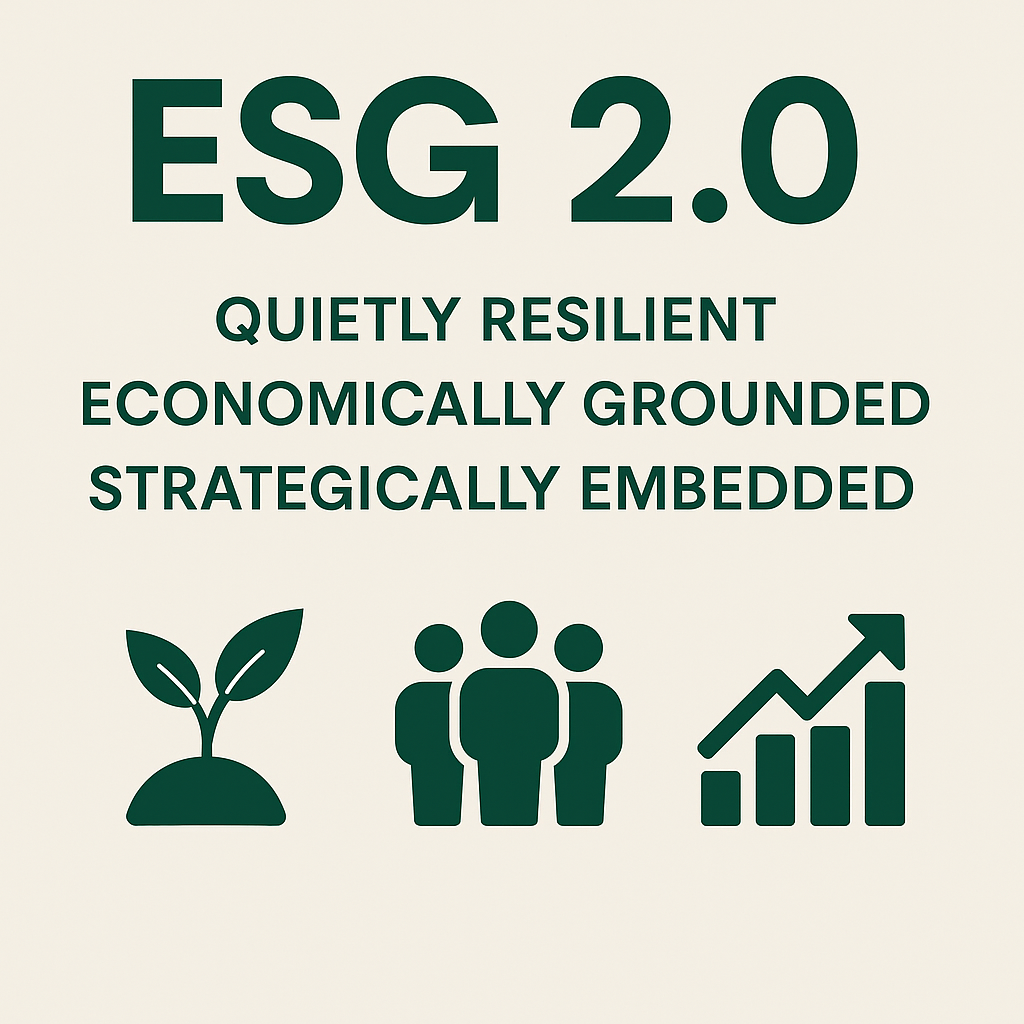
Welcome to ESG 2.0:
No longer a buzzword. No longer just a moral compass.
It’s now a strategic business engine, embedded deeply into value chains, capital markets, and C-suite priorities.
Let’s look at the evidence.
📌 3 Studies That Prove ESG Is Evolving — Not Fading
1. PwC – State of Decarbonization 2025
-
4,000+ companies now have climate targets — nearly 9 times more than in 2019.
-
37% have increased their climate ambition; only 16% have decreased it.
-
83% are investing in green products, with some seeing sales growth of up to 25%.
-
And perhaps most notably: climate targets now outlive CEO changes — meaning ESG is institutional, not individual.
ESG 2.0 isn’t about personality. It’s about policy, governance, and long-term positioning.
2. Morgan Stanley – Sustainable Signals 2025
-
88% of companies now view sustainability as a value driver.
-
83% measure ESG ROI — allowing for data-informed, performance-based decisions.
-
Companies that exceed ESG targets are increasing globally.
ESG 2.0 is no longer soft. It’s quantified. It’s comparable. It’s driving investment logic.
3. EY – Decarbonisation Barometer 2024/25
-
41% of German industry ranks decarbonisation as a top strategic priority, despite geopolitical and economic uncertainty.
-
ESG investments are focusing on Scope 3, energy efficiency, and green energy — the new economic levers.
-
60% of firms want to expand ESG investments even in downturns.
ESG 2.0 isn’t just crisis-proof — it’s becoming crisis-relevant.
🔁 So What Is ESG 2.0?
It’s not the loud, idealistic, checkbox-driven ESG of the past decade.
It’s quiet. Focused. Financially aligned. And it’s here to stay.
ESG 2.0 is:
-
Data-first — Measurable impact replaces abstract ambition.
-
Resilient — It survives leadership turnover, political shifts, and market turbulence.
-
Embedded — It’s no longer separate from the business model — it is the model.
-
Economically anchored — From Scope 3 emissions to green products, ESG is tied to bottom-line performance.
Gone are the days when ESG needed to justify its existence.
Now, it justifies decisions.
What This Means for Sustainability Professionals
If you’re still treating ESG like an add-on, a department, or a narrative — you’re stuck in version 1.0.
ESG 2.0 requires a new mindset and a new skillset:
-
Understand financial materiality
-
Master ESG reporting frameworks
-
Translate sustainability into competitive advantage
-
Build cross-functional alliances within your organization
Learn How to Lead in ESG 2.0
At ESG Academy, we’re not teaching yesterday’s ESG.
We’re preparing leaders for the ESG operating system of the future.
Explore our latest trainings on:
-
Strategic ESG Implementation
-
ESG ROI & Value Chain Impact
-
Scope 3 for CFOs and Sustainability Leads
👉 Get certified in ESG 2.0 at ESG Academy
Final Word
ESG isn’t dead.
It’s just done with being misunderstood.
This is not the collapse of ESG — it’s the consolidation of ESG into something more resilient, pragmatic, and powerful.
ESG 2.0 is here. Are you ready to lead it?